Showing posts with label learning environment. Show all posts

Monday, 23 June 2014

Innovative natural ventilation from SE Controls helps keep pupils alert


A new £2 million science centre at Moreton Hall School in Oswestry, is using an advanced NVLogiQ naturalventilation monitoring and control solution from SE Controls to maintain classroom indoor air quality while providing a stimulating and comfortable environment for pupils.

Founded more than 100 years ago, Moreton Hall is one of the UK’s highest achieving independent schools, providing education for girls from age 3 to 18 and boys from 3 to 11, together with accommodation and facilities for boarding.

The new two-storey science building provides high quality teaching laboratories for the school’s junior science, GCSE and A level students and was designed by Shrewsbury based architects, Baart Harries Newall who were keen to ensure that the building’s indoor air quality was maintained within national standards and its energy consumption was minimised.

To achieve the designer’s objectives, SE Controls worked closely with the architects and main contractors, Jones Brothers Weston Rhyn, to develop an assisted natural ventilation solution. Using compact NVLogiQ room controllers linked to automatic opening windows and a low energy cross flow fan in each of the eight lab classrooms, the system manages ventilation as well as the operation of radiators to provide a fully integrated low energy system.

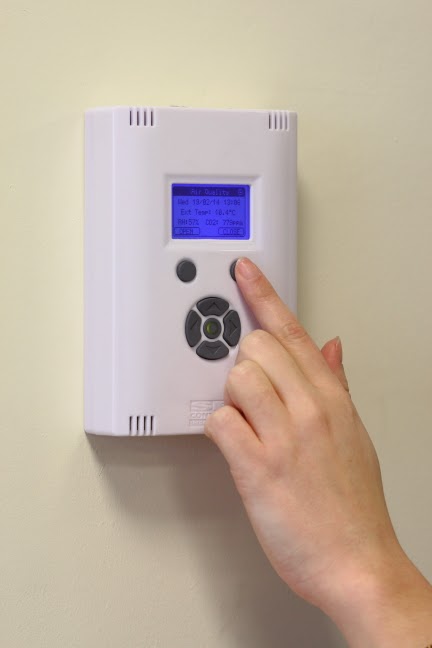
The NVLogiQ room controllers constantly monitor carbon dioxide (CO2) levels in each classroom alongside indoor air temperature and relative humidity, as well as outside temperature, wind and rain via external sensors. Each NVLogiQ unit also incorporates an integral data logger to allow the recording and analysis of all key aspects of the room environment.

The sophisticated monitoring and control algorithm used within the compact NVLogiQ system was developed in conjunction with Loughborough University’s School of Civil and Building Engineering to ensure indoor CO2 levels and temperatures are precisely controlled while minimising building energy losses.

In addition to the eight NVLogiQ controllers and PSUs, 18 SECO N 24 40 400N twin chain compact actuators were also installed by SE Controls together with PIR finger trap sensors and all the appropriate cabling to control the automatic opening of windows and the small cross flow fans in each lab.

During normal operation, as CO2 levels increase within each individual science lab, the NVLogiQ controller triggers SE Controls’ SECO N 24 40 compact chain actuators to begin the incremental opening of the windows to allow fresh air to enter the classroom. Simultaneously, small dampers located on the wall opposite the windows are signalled to open and the low energy fans start to draw air from the room to stimulate cross flow and aid ventilation.


Dr. Chris Iddon, SE Controls’ Design Manager, explained: “There are already a significant number of high quality studies that have identified a clear link between increased internal CO2 levels and a reduction in the ability of students to learn and perform optimally.”

He added: “Post occupancy monitoring of the Moreton Hall classroom environment has shown excellent indoor air quality proving that the design is an example of how having a clearly defined, controlled and executed ventilation strategy can maintain a high quality and stimulating classroom environment for students. Using NVlogiQ enables excellent on demand ventilation whilst minimising heating energy demand.”  


SE Controls specialises in the design, project management and installation of advanced smoke ventilation and natural ventilation solutions to meet the needs of architects, contractors, building services engineers and facilities managers worldwide. Further information on SE Controls’ products, solutions and projects can be obtained by visiting www.secontrols.com or calling

 +44 (0) 1543 443060.

Monday, 7 October 2013

Precision Ventilation Control for Sheffield University NAMRC


Precision window actuators from SE Controls are being used as part of an energy efficient natural ventilation system at Sheffield University’s Nuclear Advanced Manufacturing Research Centre (NAMRC) in Rotherham, to help maintain a comfortable environment for researchers and staff.

Work at the NAMRC focuses specifically on innovative research into metals and manufacturing engineering, rather than radioactive research and the new BREEAM Excellent rated building, which was designed by Bond Bryan Architects, is based around an open plan 5,000 m2 workshop that incorporates cutting edge manufacturing equipment and facilities.

As the building already employs low energy and renewable initiatives, such as 320kW ground source heat pumps and a 900kW wind turbine, the use of natural ventilation was an ideal solution, as the temperature and air quality can be maintained within clearly defined set points while minimising the need for additional mechanical cooling.

To provide the high degree of control required, SE Controls, supplied, installed and commissioned a range of chain actuators, which are linked to the NAMRC building management system and are used to control the operation of the high and low level vents.

Twenty TGCO 24 15 actuators with a 350mm stroke length were installed on the building’s high level exhaust vents, while the need to protect against finger entrapment on the low level louvres prompted the selection of eighteen SE Controls’ TGCO 24 20 ‘Easi-Drive’ compact actuators each with 160mm stroke length.

SE Controls’ Project Manager, Darren Wainwright, explained: “It is absolutely vital that the natural ventilation strategy and system perform as designed to allow the right amount of fresh air to enter the building while ensuring that heat energy is not lost unnecessarily during the process. By using precision actuators to provide incremental operation of the system’s vents and louvres, it helps ensure that required performance is within the specified design parameters.”

SE Controls specialises in the design, project management and installation of advanced smoke ventilation and natural ventilation solutions to meet the needs of architects, contractors, building services engineers and facilities managers worldwide. Further information on SE Controls’ products, solutions and projects can be obtained by visiting www.secontrols.com or calling

+44 (0) 1543 443060.

Wednesday, 10 April 2013

Indoor Air Quality In Schools – Is It Making The Grade?


The new Priority School Building Programme (PSBP) Facilities Output Specification, launched last October by the Education Funding Agency, proposes some significant, positive and welcome changes to school ventilation specifications, when compared to the existing BB101 standard.

Alongside ventilation and carbon dioxide levels, it also provides clear guides on specific performance standards for thermal comfort while recognising that indoor air quality, ventilation strategy, temperature, humidity and energy efficiency are all intrinsically linked.


However, given that the PSBP is aimed at renewing, repairing and refurbishing some of the country’s most dilapidated schools, the question has to be asked about what happens to those schools that are not especially out of date or in poor repair? Will schools that fall outside the scope of PSBP and its associated funding find that their pupils suffer as ‘legacy’ classroom designs struggle to meet the new standards, particularly for CO2?


Classroom carbon dioxide levels exceed BB101

In the last quarter of 2012, we ran a pilot test with a small number of ‘non-PSBP’ primary schools in the Midlands and Northern Home Counties to gauge the actual level of CO2 in classrooms.

Using our NVLogiQ room controller’s integral CO2 sensor and data-logging function to monitor and record carbon dioxide levels for later analysis, it’s front panel display also acted as a ‘traffic light’ system for teachers, alerting them that the levels were increasing and they should manually open windows to improve ventilation.

When the initial data was analysed in January this year, the headline results raised some significant concerns and were as follows:

·         For most days, the daily average occupied CO2 level exceeded the recommended 1500ppm figure in BB101.

·         In some cases the CO2 figure was between 2500ppm and 3700ppm on every day of the week.

·         BB101’s maximum 5000ppm level was breached four times per week in some cases.

·         A maximum reading of 7200ppm was recorded, resulting in the CO2 levels exceeding 5000ppm for almost 3 hours in one case.

While this is a relatively small pilot programme, the results appear fairly consistent and suggest that air quality in schools is probably not as good as it should be. It also raises some general questions about verifying the performance of building ventilation systems in schools.

Clearly the new PSBP output specification sets out to address the issue of CO2 levels, but as some schools are already struggling to comply with the less stringent existing standards, it is evident that any PSBP compliant system must be designed correctly and controlled effectively.


Control is the key

In ‘post-test’ de-briefings, teachers said they were too busy to constantly monitor and respond to ‘traffic light’ signals, so relying on manual opening proved to be unviable due to the intrinsic lack of precise control

Unless automated ventilation solutions are adopted, such as window automation linked to dedicated monitors and controllers or a hybrid mixed mode system to provide additional backup, then it’s likely that children and teachers will continue to work in poorly ventilated and non-compliant schools with the inevitable result of reduced learning performance.

By utilising devices such as NVLogiQ, which can be configured to operate either as a networked system or be dedicated to individual areas, classroom CO2 levels, temperature and energy efficiency can be managed as an integrated set of parameters to provide optimal ventilation while saving energy and money.


Performance monitoring and ‘Soft Landings’

While the value of effective monitoring and logging of CO2, energy efficiency and other parameters provides a constant source of information for analysis and system ‘tuning’, the real benefits come from long term building performance and environment monitoring. This information allows consultants, contractors and school facilities mangers to understand and refine a building’s overall performance.

This facility has even more value within the framework of BSRIA’s Soft Landings programme, which formally establishes a process of managed and extended handover from contractor to owner or occupier to help create a culture of ‘shared responsibility and co-operation’.


A learning environment

PSBP provides a tremendous opportunity to bring our schools up to date with quality facilities and better, more comfortable energy efficient buildings.

It’s evident that the ventilation industry and the education sector have learned a lot since the original introduction of BB101, yet the issues identified in our classroom CO2 pilot study suggest that while there are still some lessons to be learned, the ventilation solutions are already available.

SE Controls’ 30 years of experience in creating and installing natural ventilation solutions in a diverse range of sectors, alongside an ongoing commitment to rigorous academic research, equips us with skills and technologies that can help make PSBP work, while helping improve building performance overall.